by Andy Tindle, Peter Sleep and Tom Cotterell.
This book is currently in preparation and is expected to be available late in 2026. Advanced subscription is advised as copies will be limited.
The ~500 page work represents an expansion of a digital interactive book produced with Royal Cornwall Museum (Truro) about 7 years ago. That volume, now available on this website, contains photographic copies of all the pages (text and illustrations) in Philip Rashleigh’s two books published in 1797 and 1802. In addition, the volume also includes transcripts of the text and photographs of the illustrated specimens currently residing in Truro.
The new book uses this content and expands it considerably with the addition of photographs of the other main part of the Rashleigh collection – in the Natural History Museum (NHM), London. These specimens were bequeathed to the museum by Sir Arthur Russell and form part of his extensive collection of British minerals.
To this, we aim also to add photographs of specimens from Rashleigh’s collection that for various reasons did not make it into his books (he collected long after the second book was published and his heirs also added to the collection after his death). We have uncovered some remarkable specimens that have never been on display – enough for us to have a section titled ‘the great and the good’. We also plan to include a discussion on the provenance of some Rashleigh specimens, in particular the copper arsenates (liroconite, clinoclase, pharmacosiderite, olivenite etc.) as the story is far from straightforward.
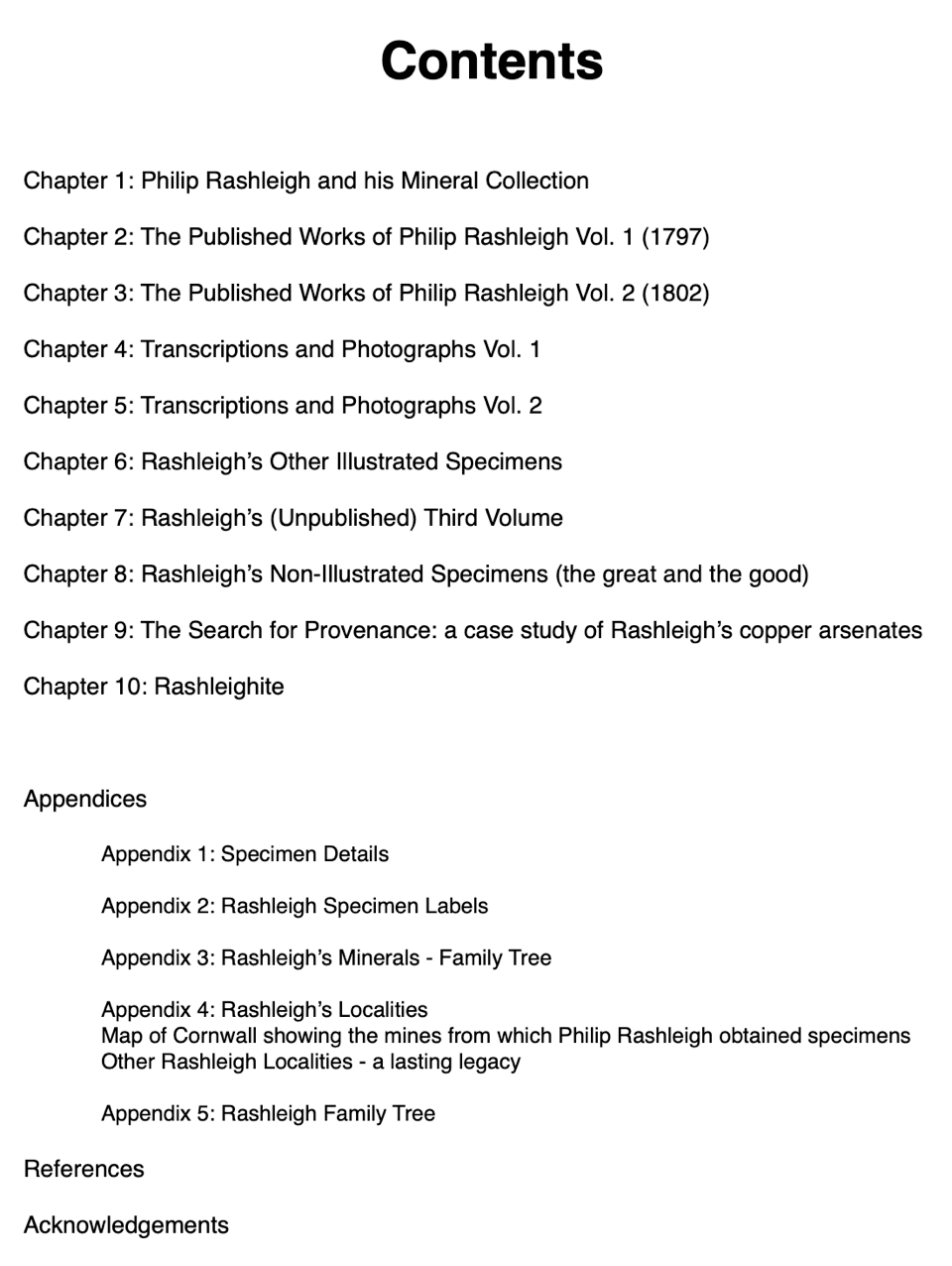
For completeness we have included some supplementary material including examples of ‘rashleighite’, now a discredited species (a variety of turquoise), curatorial details of specimens and labels, a Rashleigh minerals chronological tree, a map of Rashleigh’s Cornish localities, details of other Rashleigh localities to reflect the impact that the Rashleigh family have had in Cornwall (memorials, buildings etc.) and finally we plan to include a Rashleigh family tree (beginning in 1100 AD to the present day – 28 generations so far).
In summary Rashleigh’s Minerals will contain:
- Complete reproduction of the figures and text of the two volumes of “Specimens of British Minerals”
- Photographic images of all the figured specimens whose location is known – Truro and NHM, London. The new book will generally show multiple views of each specimen.
- Photographic images of remarkable specimens in the museum collections that are not figured in Rashleigh’s books
- An examination of the provenance, particularly of arsenates, where more recent collectors and curators have revised the location
- Twenty-three plates from Sowerby’s British Mineralogy (1804-1817) – selected because they show specimens Rashleigh gave or loaned to Sowerby. A few of the original specimens have been tracked down and photographed.
- Some Rashleigh illustrations that were not used in his books and perhaps these were destined for an unpublished third volume? Some of the illustrations were made by three of Rashleigh’s relatives, others are by Sowerby.
- A new chapter subtitled the “great and the good”. For all the magnificent specimens that never made it into his books. The world famous liroconite crystal is one such specimen. The world’s largest clinoclase crystal is another. All fully photographed.
- The mineral described as ‘rashleighite’. Two specimens of this non-IMA approved species are illustrated.
- Appendices have been enlarged – one covers labels attached to specimens and unattached labels with the specimens. They are quite varied from Rashleigh hand-written ones to modern museum ones.
- The Rashleigh legacy – covers Rashleigh memorials in churches, almhouses, mines, public houses, a stone hewn bath, museum galleries, fish cellars, and roads. It’s an interesting insight on how important the Rashleigh family was, particularly in the St Austell/Fowey area.
- Other associated background material e.g. a family tree that goes back to 1100 AD – 28 generations.
Future Publications
Alongside Rashleigh’s Minerals we are also working on a second (more specialised) book – a transcript of Philip Rashleigh’s 1780-1811 mineral catalogue. With the help of the Royal Cornwall Museum (now called the Cornwall Museum and Art Gallery), the NHM and Courtenay Smale we are creating a volume based on the original catalogue matched with another catalogue created in 1814 by Arthur Aikin with the addition of museum specimen numbers and comments that museum curators and experts (such as Sir Arthur Russell) have made over the last 100 years. To this we have added our own observations and discoveries. A volume of perhaps 300 pages is expected.